The ThunderDragon has moved!

You should be automatically redirected in a few seconds. If not, please visit
http://thethunderdragon.co.uk
and update your bookmarks/blogroll.

Showing posts with label Opinion. Show all posts

20 October 2007

Birth Order Advantages?

Is it now "official" that first-borns are smarter?

In June, for example, a group of Norwegian researchers released a study showing that firstborns are generally smarter than any siblings who come along later, enjoying on average a three-point IQ advantage over the next eldest—probably a result of the intellectual boost that comes from mentoring younger siblings and helping them in day-to-day tasks. The second child, in turn, is a point ahead of the third.
To a certain extent that is true. But considering that IQ tests actually reveal little more than the ability to take IQ tests, and that three points is a really minimal amount, I think that it can be put down primarily to issues with the IQ test itself. And the way in which each individual's brain is wired to deal with the problems. My older brother is far more mathematical and scientific than me, but lacks any real creativity or imagination, almost a diametric switch to me. We have different interests and specialities. I wouldn't say he's more intelligent than me, but his brain works in a different way.

But being the second of three boys, this is the bit that interested me most:
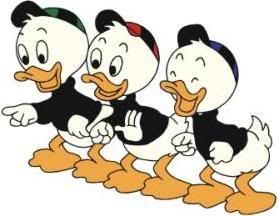
If eldest sibs are the dogged achievers and youngest sibs are the gamblers and visionaries, where does this leave those in between? That it's so hard to define what middle-borns become is largely due to the fact that it's so hard to define who they are growing up. The youngest in the family, but only until someone else comes along, they are both teacher and student, babysitter and babysat, too young for the privileges of the firstborn but too old for the latitude given the last...
Stuck for life in a center seat, middle children get shortchanged even on family resources. Unlike the firstborn, who spends at least some time as the only-child eldest, and the last-born, who hangs around long enough to become the only-child youngest, middlings are never alone and thus never get 100% of the parents' investment of time and money.
This is something which I have very much noticed all through my life. But is it really being "shortchanged"? Maybe in purely financial or resource-specific ways, but in the long term as a human being, I disagree - it has made me be far more able to deal with a greater range of situations than my brothers. I don't have to lead like my older brother does but I can, and I don't have the greed and feel the need to differentiate myself from others like my younger brother. I can adapt to fit the situation. I can lead and follow, teach and be taught. This bit, however, it utter bollocks:
Siblings who hope to stand out in a family often do so by observing what the elder child does and then doing the opposite. If the firstborn gets good grades and takes a job after school, the second-born may go the slacker route. The third-born may then de-de-identify, opting for industriousness, even if in the more unconventional ways of the last-born. (TIME)
When it comes to birth order, it really makes very little difference in the long run. They give different advantages and disadvantages. The gap in the IQ test is minimal and within the accuracy of IQ tests. The social differences allow people to fit into different niches. Birth order itself doesn't give benefits without disadvantages, or vice versa.

Source: TIME

07 October 2007

Guns

This demonstrates just one of the reasons why I am against guns being freely available to anyone, for any reason. Gun control is essential in a modern society. Guns don't kill people themselves, but they are used to kill people - and do that job extremely easily.

I certainly wouldn't feel safer with a gun or with all police officers being armed - if the police have guns, the criminals then need them too. Gun crime may be on the rise in Britain, but it certainly isn't anywhere near the level of that in America. In Hertfordshire, the last time a policeman fired a gun in anger was about 1985 - the year I was born.

Guns breed guns. If people have guns, criminals need them too. If they don't, few criminals have them. And then there are fewer guns around, so fewer shots get fired, and fewer people die.

25 September 2007

He's Leaving The Party

Morningstar says that he is leaving

The Conservative party, I’ve had enough.
I’m not going to stop being a C/conservative, but I am just so fed up of trying to delude myself that the Conservative party speaks for me any longer...
All we hear from “Dave” is middle of the road, centre ground, middle England, middle classes, and it’s bollocks, the politics of mediocrity, selling out to the lowest common denominator. In PMQs the odd scripted remarks draws laughs but he isn’t thinking on his feet, he has his script and it fails him too many times.
I’m fed up of it...
So when CCHQ sent me a letter which asked me to join my local association, instead of a national membership through the Conservative party website, I started to think long and hard.
Today I decided that I’m not going to renew.
That's fair enough. But then he adds in the comments:
At the moment I couldn’t say who I will support in an election as I still don’t have the slightest idea of what the Conservative party stands for any longer.
It may be that I don’t vote at all at the next election...
Which is pretty damn stupid, really. In a follow-up post on the same issue, he also says:
I won’t vote for the New Stalinistas, and I won’t vote for Ming the muddled, but I’m also not going to vote for a bogus Conservative party that doesn’t have policies I can support either. It might keep Brown in power, but that is how democracy works...
Now I just need to start looking at the other parties and their policies, let’s see whose most match with my own views.
The problem with that if he won't vote for Labour or the Lib Dems or the Conservatives, his vote will have pretty much no point, or even be possible since not all seats will have other parties contesting them, let alone the party you choose. We only have three decent sized parties in our political system, and only two with any chance of winning an election. Labour and the Conservatives. The choice is thus pretty much just between them.

No person agrees entirely with another person. Be it on minor issues or huge ones, there will be differences between each and every person. Thus no party can ever possibly completely represent you and hold all of your views within it - unless, of course, you are the leader, and not even necessarily then. Thus we have to make compromises. I don't agree with everything that the Conservative Party says or does, plenty of which has been documented at one point or another on this blog - and will continue to be.

Our political system means that if you don't vote for one of the three main parties, your vote is almost always completely wasted. Thus you have to compromise, and choose the party who you most agree with and who represents your views more than the others from those three and vote for them. Whilst that doesn't mean that you should stay as a member of a party that you are not sure fully represents your views any more, it does mean that you should still vote for them - or you are giving those with whom you agree with least more chance of getting in. That is simply how this system works.

Brown's Speech

The best and pithiest response to Gordon Brown's speech at the Labour Conference that I have read has to be John Redwood's. He sees right through Brown's boring rhetoric used to ensure that nothing he actually says is ever really paid attention to, but just what his spin doctors tell the media he said. Under the title "Using the word British or Britain more than 70 times doesn’t make you a patriot" he writes:

Gordon Brown delivers a dull speech with many references to Britain and our island story - spin.
Gordon Brown backs a further large transfer of power to the EU - reality.

Gordon Brown says he is going to restore faith in politicis [sic] by listening to people - spin.
Gordon Brown refuses a referendum on the constitution - reality.

Gordon Brown says he wants jobs and prosperity for all - spin.
Gordon Brown presides over an overtaxed and over regulated economy where 5.4 million adults of working age have no job - reality...

That was no Conservative speech.
Read his full post to find out what he thinks a real Conservative speech should contain. Will david Cameron's speech at the Conservative Conference meet this? Only time will tell.

UPDATE: West Brom Blogger has put Brown's speech through a tag generator. A very cleaver idea, and it has some interesting results.

22 September 2007

Miranda Grell

She's guilty.

A Labour councillor has been found guilty of falsely branding a Liberal Democrat rival a paedophile and telling electors he had sex with teenage boys.
Miranda Grell slurred gay Lib Dem candidate Barry Smith while campaigning for the Leyton ward in Waltham Forest Council, east London, in 2006.
Grell, 29, was convicted by magistrates of two counts of making false statements about another candidate.
She was handed a £1,000 fine and will be forced to vacate her seat...
A Labour Party spokesman said Grell had been suspended from the party pending an internal investigation. (BBC)
You can't help but feel sorry for her. She is said to have been a "rising star in Labour ranks" and now she has lost her council seat and been suspended from her party. Quite a come-down.

I doubt, however, that she did it on purpose. It is far more likely to have been just an indiscreet, and very ill-advised, slip of the tongue. I don't think she's likely to be stupid enough to have deliberately set out to smear her opponent - as much as my political prejudices may make me like to believe that she did.

I feel sorry for her. She has lost so much now, as well as many possibilities for the future. If she ever stands for public office again, this case will constantly rear its head. It is the sort of thing that could happen any politician, a foolish and indiscreet remark putting paid to a potential future career.

No party can claim to have had no problems in the past. There can be rotten apples in any basket, after all. No political party has an immaculate yard. What happened to Miranda could happen oh-so-easily to numerous others.

Image: Miranda Grell
Sources: BBC, The Times

16 September 2007

With A Little Help From Facebook Friends

Sam Coates [of the Times, not ConervativeHome] is writing the Times' News Blog during the Conference season. His latest entry is on the Lib Dems Conference focuses on the discovery of Facebook by politicians:

With the dreary inevitability of the uncle on the wedding dance floor, politicians have stumbled across Facebook and are busy admiring pictures of themselves beaming away on the profile page.
Is this an innovative way of tapping into the somewhat nebulous "new politics" concept? Or do you, like I did, read the following passage from the speech by Steve Webb - the party's manifesto chief - and weep... [read the rest]
I have to say that I disagree with him. I think it is a good thing that politicians have discovered Facebook, if they use it to actually connect with young people. It's all too easy to write it off as a gimmick and as a cringe-worthy attempt to be "down with the kids" but if they actually use it to connect with and listen to the young people in their constituency, then it can be nothing but an unqualified good.

The reason that young people are often seen as disconnected from politics is because it operates in a different way to them, in different spheres of human life and society. Politicians have a duty to attempt to connect with all members of the electorate, and they're not able to connect with the vast majority of young people through the normal means.

Facebook is a good way for politicians to link with young people in their constituency. They can connect with them and hear their opinions. They can find out which issues most concern them, and what they think could or should be done about them.

That politicians are ready and willing to take the initiative to get in contact with and listen to the concerns of young people is certainly a good thing. They should do everything that they can in order to get young people interested in politics, and to hear their opinions.

Even if it can be as cringe-worthy as the uncle on the wedding dance floor.

08 September 2007

Q. Wouldn't You Feel Safer With A Gun?
A. No, I Wouldn't.

In today's Times, a comment article has been written entitled "Wouldn’t you feel safer with a gun?" and claims that "British attitudes are supercilious and misguided".

My answer to the question is a very simple "No, I wouldn't".

Guns don't kill people, people kill people. But people use guns to kill people. The more guns there are in open circulation, the more deaths there are going to be from been shot. A gun makes it very easy to kill. Point, aim, shoot. Bang, they're dead.

The less guns there are in open circulation, the safer I feel.

If everyone has a gun, a criminal with a gun knows this, and will thus shoot to kill, and shoot and kill, far more so than if no-one has - so he knows that no-one can shoot and kill him, and thus doesn't feel a need to strike first.

Yes, if someone goes on a rampage with a gun someone else with a gun can shoot back and stop them - but if guns weren't in such open circulation in the first place, it would be far far harder for that person to get a gun to go on the rampage with.

The more guns that are available, the more people will die. Yes, people still die if guns aren't in open circulation, but far fewer. Through guns comes death. It's as simple as that. And that is why I feel safer with gun control - because if I have a gun, so does the person behind me, and that scares me far more than if someone starts shooting I can't shoot back.

04 August 2007

The Political Opinion Of 'Yoofs'

"I'm only 18 - but my opinions are important. It's my generation that will have to clean up after you" claims an article on Comment is Free. Matthew Sinclair deals with most of rubbish he spouts, but there is one point in the CiF article that I want to address, the one in the title quoted above - "I'm only 18 - but my opinions are important". In the article, Charlie writes:

"[Y]oung people feel strongly about things that will affect them... To dismiss young people's opinions simply because they are young is ridiculous; no wonder so many of my friends have no interest. If we aren't allowed to participate in debates with the older generation, what is the point of our becoming interested in politics?...
So let's stop moaning about our young people. We have opinions and ideas on political issues , and it would be nice to be able to express them. Let us get involved in decision making - and, just once in a while, talk about the positive things that we're doing rather than the negative."
The opinions of young people tend to be dismissed for one very simple reason: they have nothing - or very little - to base them on. An 18 year old's opinion has less "value" than that of a 40 year old because the 40 year old has life experience on which to base them. At 18, you have no real life experience. All your life you have lived at your parent's home and under their protection. Your opinions are immature, unformed, uninformed, and easily manipulated - and very much the result of school indoctrination [for lack of a better word].

At 18 you think you know everything. I know I did. You think your opinions are intelligent, well though out and based on sound principles - but, of course, they're not. They're based on bullshit. 18 year olds know little or nothing about the real world outside of the closed and structured environment of school, where you are effectively spoon-fed ideas and answers. When you finally leave that safe environment and move out, you begin to realise that where you are wrong, and that things aren't like you thought they are or would be.

Over the last four years at university, I have learnt a significant amount about life - but I know I still have a hell of a long way to go. But the first, and arguably most important, step is realising that your opinions are almost certainly wrong in at least one way, and that experience can and will teach you where that is. That is why an 18 year old's opinion means little. Even that of a 22 year old like me doesn't mean all that much - but I know why it doesn't. As a mark of how opinions and understandings change, even just over the last year when I have been writing this blog, my opinions have significantly adapted and matured - and that is one of the reasons why I blog.

The voice of the 'yoofs' isn't taken too seriously for one main reason: because they don't mean squat yet. There is no real foundation on which they have been built, and they will change as you grow up. Mine have [and will continue to do so, I'm sure], and yours will. In forming opinions, experience is key - and 18 year olds simply don't have any.

Template Designed by Douglas Bowman - Updated to New Blogger by: Blogger Team
Modified for 3-Column Layout by Hoctro
Extensively edited for this blog by ThunderDragon
eXTReMe Tracker